FishStrike: win real cash
- 4.7
- Rating
- 100.00K
- Installs
- Free
- Price

 Analysis by App-foxy
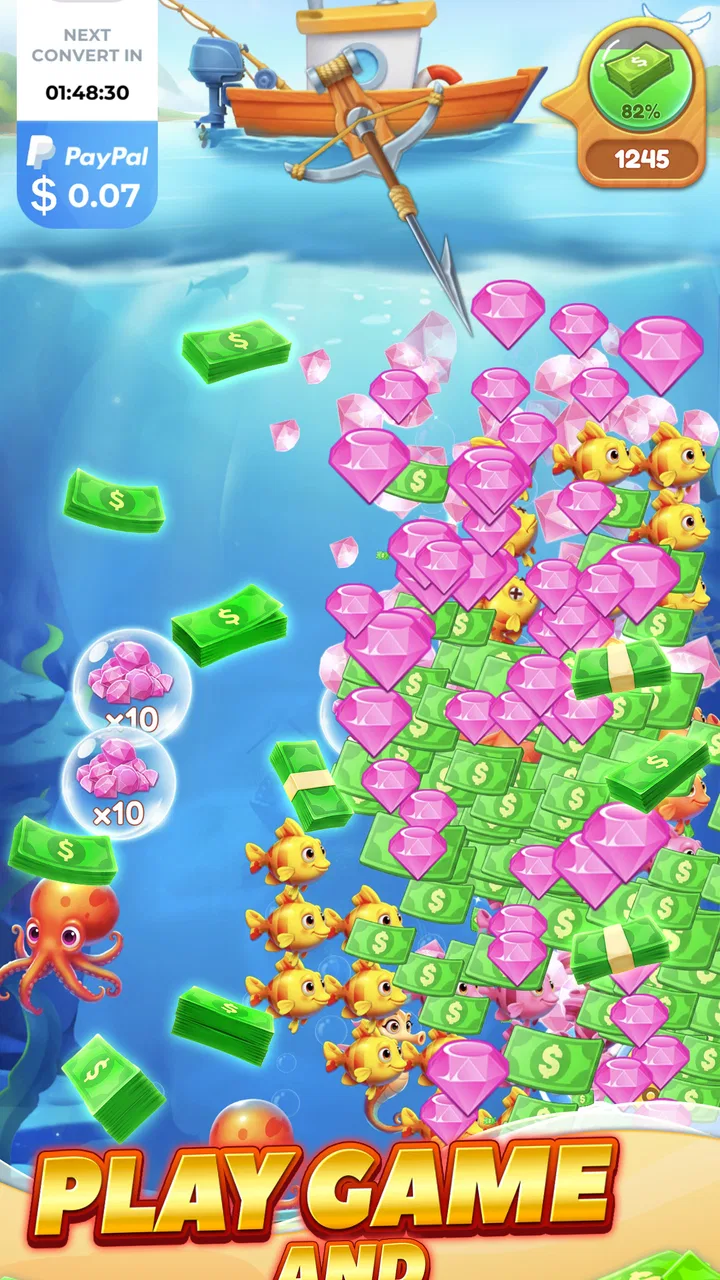
I went into FishStrike expecting a lightweight fishing game and quickly noticed that its main appeal is not deep simulation. It is built around a simple loop: catch fish, build up diamonds, and work toward cash rewards through PayPal. That straightforward goal gives each short session a clear purpose, especially when I only have a few spare minutes.
This is a free casual game from Omarguanhs, rated for Everyone and available for devices running Android 9 or later. Its store presentation is extremely brief, so the real question is whether the reward-focused loop feels pleasant enough to return to. In my experience, the answer depends heavily on what you want from a mobile game. If you enjoy small, repeatable tasks with a visible target, it has an immediate hook. If you want a rich fishing system, a developed story, or a carefully simulated ocean, this is not the right place to look.
My first impression of the fishing loop
The opening experience is easy to understand because the game does not ask me to learn a complicated control scheme. Catching fish is the central activity, and the reward structure keeps the purpose visible. I always know why I am playing the next round: I am trying to increase my diamond balance and eventually reach the point where a reward can be converted through PayPal.
You May Also Like

 Pandora - Music & Podcasts
Pandora’s Music Is Easy to Start, but Harder to Recover
Pandora’s strength is its low-effort path from a seed to a station. Its weak spot is how much confidence it asks you to place in connection, setup, and quiet recovery.

 8 Ball Pool
 Is Built on Rivalries, Rematches, and Routine
A close look at the rivalries, rematches, shared routines, and unanswered safety questions that turn a quick pool match into a persistent mobile community.

 Samsung Music
’s Quiet Strength Is Playing What You Already Own
Its reach comes less from spectacle than from dependable access to a personal library. That simplicity is both the app’s strongest retention engine and its ceiling.

 AccuWeather: Weather Radar
AccuWeather Review: A Quick, Clear Forecast for Everyday Decisions
For everyday plans, the best forecast is the one you can understand quickly. AccuWeather makes rain timing, radar, and local conditions easy to act on, with a few trade-offs.

 Hill Climb Racing
Why Hill Climb Racing Still Turns Crashes Into One More Run
A tiny car, a bumpy hill and one more upgrade: Hill Climb Racing keeps resurfacing because its simple chaos makes every near-miss feel personal.

 AliExpress - Shopping App
AliExpress Makes Global Shopping Feel Personal, but Shoppers Bear the Risk
AliExpress turns a global marketplace into a pocket-sized discovery engine. Its reach is useful, its shopping loop compelling, and its trade-offs easy to miss.
More From Our News Desk
View All News


That clarity is one of the game’s strongest qualities. Many casual games bury their main objective under several currencies, upgrade screens, missions, and timed menus. FishStrike feels more direct. I can open it, play for a short while, and leave without needing to remember a long chain of tasks. For a casual title, that low mental load matters more than elaborate presentation.
The trade-off is that a simple loop can become repetitive. The game’s appeal comes from the rhythm of catching and accumulating rather than from a large range of activities. I would not install it expecting a campaign with changing locations or a detailed progression tree. I see it more as a small routine than a major game: something to check during a break, while waiting for transport, or when I want a low-pressure distraction.
The reward promise also changes how I judge the experience. In a normal fishing game, catching fish is the entertainment by itself. Here, the diamonds and PayPal goal become part of the motivation. That can make ordinary actions feel more purposeful, but it also means I pay closer attention to progress than I would in a purely decorative fishing app. My advice is to treat the reward path as a bonus and judge the game first by whether the fishing loop is enjoyable on its own.
There is a practical detail worth keeping in mind: the store summary says diamonds can be converted to real PayPal rewards every three hours. That timing creates a natural reason to return later instead of playing endlessly in one sitting. It also makes the game better suited to spaced-out check-ins than to long sessions. I found that this kind of pacing is less tiring, although players looking for continuous action may find the waiting structure restrictive.
A small game with a clear audience
FishStrike fits people who like casual progress, uncomplicated interactions, and a reward target they can understand quickly. It may work particularly well for someone who already enjoys checking small games throughout the day rather than committing to one long session. The Everyone age rating also makes its tone broadly accessible, although adults should still approach the cash angle with realistic expectations rather than treating it as an income source.
I would skip it if my priority were competitive fishing, realistic equipment, exploration, or a strong narrative setting. A conventional fishing simulator would be a better choice for learning species, managing tackle, or enjoying a more detailed environment. A traditional arcade game would probably suit me better if I wanted constant action without a reward-conversion rhythm. FishStrike occupies a narrower space: casual fishing tied to accumulation and redemption.
One useful way to play is to decide in advance how long a session should last. Because the loop is easy to repeat, it is tempting to continue simply because the next reward feels close. Setting a short personal limit keeps the game in its intended casual role and prevents the reward goal from turning a relaxing activity into a chore. I also prefer checking my progress at the end of a session rather than interrupting every catch to watch the counter.
How the visual language supports the mood
The game’s fishing identity is communicated through a focused setting rather than through a large fictional world. That focus helps the experience feel coherent: the activity, the currency, and the reward goal all point in the same direction. I do not get the impression that the game is trying to be a dramatic adventure. Its visual language is more functional and inviting, designed to keep attention on the next catch and the growing balance.
That restraint is useful on a phone. A busy interface would compete with the central action, while an overly detailed environment could make a short session feel slower. FishStrike benefits from keeping the idea of fishing immediately readable. I can understand the mood without needing a long introduction or a complicated explanation of the world.
At the same time, the limited scope means the setting is not the main reason I return. The game does not replace a full fishing adventure with a broad sense of place. Its environment works as a backdrop for the loop, not as a destination I explore for its own sake. This is an important distinction for anyone choosing between it and a more atmospheric fishing title.
The strongest design choice is the connection between visual context and progression. Diamonds do not feel like a random collectible added to an unrelated game; they are part of the path toward the stated reward. That gives the interface a practical coherence. I am not collecting objects merely because a menu says so. I am building toward a specific action, which makes the otherwise modest presentation easier to follow.
There is also a subtle pacing advantage in not overloading the screen with information. Casual games often become tiring when every action produces several pop-ups, badges, and competing goals. FishStrike’s central idea is easier to keep in mind. For me, that makes it more comfortable as a background game, although players who enjoy unlocking layers of content may find the presentation too restrained.
Why the setting works better in short sessions
The fishing setting creates a calmer expectation than a combat or reaction-heavy game. I can approach it when I want something less demanding, and the reward loop gives that calm activity a little structure. The result is a playable mood built around repetition, anticipation, and small progress rather than urgency.
That mood is most effective when I use the game as a pause between other tasks. For example, I might play while taking a short break from work, stop before the session becomes repetitive, and return later when the next three-hour reward window makes sense. In that scenario, the setting and the pacing support each other. The game becomes a small ritual rather than an attempt to fill an entire evening.
It is less convincing as a long-form escape. If I want to sit down for an hour and feel that I have traveled through different waters or mastered a complex system, the limited fishing loop will not provide enough variety. The setting establishes the mood, but it does not carry the whole experience by itself.
Sound, rhythm, and the feel of each return
Sound is especially important in a game this simple because audio can make repeated actions feel satisfying or expose their repetition. FishStrike’s overall rhythm is built around brief cycles: start a session, catch fish, watch the diamond total develop, and decide whether to continue or come back later. Even without a complex soundtrack or dramatic set pieces, that structure can create a gentle sense of momentum.
I like the fact that the game’s rhythm does not demand constant concentration. It is easier to fit around real life than a game that punishes every pause. The fishing theme supports that relaxed tempo, while the reward interval gives the day a loose pattern of returns. The result feels closer to checking a familiar pastime than entering a long match.
The limitation is that rhythm alone cannot hide a lack of variety forever. Repetition feels comfortable at first, but after several sessions I become more aware of how similar the actions are. This is where expectations matter. I find the game more enjoyable when I approach it as a casual routine, not as a soundtrack-driven arcade experience that must keep escalating.
A practical tip is to play with the phone’s general sound level set to whatever feels comfortable rather than expecting the audio to carry the experience. The game’s core value is in its interaction and progression, so I would not choose it specifically for a rich musical atmosphere. Players who need strong sound design, expressive character voices, or dramatic audio feedback will likely prefer a more ambitious title.
The three-hour return cycle also affects the emotional rhythm. It prevents the reward path from being entirely immediate, which can make each later check-in feel more deliberate. However, it introduces friction for anyone who expects every session to produce a quick cash-related result. I see this as a pacing tool, not a guarantee of fast progress. The game is at its best when I accept that the reward goal is gradual.
Where the mechanics fit, and where they fall short
The mechanical design is easy to grasp because it revolves around one recognizable action and one understandable progression resource. That makes FishStrike approachable for casual players who do not want tutorials filled with technical terms. The game also avoids the common problem of making the first few minutes feel like account management rather than play.
The important question is whether the fishing action remains satisfying once the novelty fades. For me, the answer is mixed. The clear reward target gives the loop more direction than a purely decorative tap game, but it does not automatically create depth. I still need to enjoy the repeated catches themselves. If I am motivated only by the promise of a future reward, the sessions can start to feel transactional.
The PayPal connection is the feature that most clearly separates this game from ordinary casual fishing alternatives. It gives the diamond balance a real-world purpose, but it also makes the experience more sensitive to redemption expectations. I would read the in-game instructions carefully, keep track of the relevant timing, and avoid assuming that a visible balance is the same thing as immediate money. The game’s own stated rhythm is every three hours, so patience is part of the design.
Another useful trade-off is the relationship between session length and progress. Longer play may feel productive, but the game’s casual structure makes short, repeated visits more natural. I would use it in small blocks and judge progress over several returns rather than after one extended attempt. That approach reduces frustration and suits the way the reward cycle is presented.
Compared with a standard idle game, FishStrike gives the player a more concrete theme and a clearer action instead of leaving progress entirely in the background. Compared with a normal fishing game, it places much more emphasis on diamonds and redemption than on technique or simulation. Compared with reward-based apps that use surveys or offers, it is more game-like because the central activity is fishing rather than completing unrelated tasks. Each comparison reveals the same point: this is a hybrid, and its best audience is someone who wants a casual game with a reward-oriented objective.
Questions I would answer before installing
Is it genuinely free to start? Yes, FishStrike is listed as free, which makes it easy to try without paying an entry price. I would still approach any reward-focused game with the same care I use for other apps: understand the progression, avoid treating it as guaranteed earnings, and decide whether the play is worthwhile even when I am not actively thinking about cash.
Can children use it? Its content rating is Everyone, so its presentation is intended for a broad audience. Even so, the PayPal element is more relevant to adults or supervised users because handling rewards and accounts is a separate practical matter from playing a casual fishing game.
How often should I return? The stated conversion timing points to a three-hour rhythm. I would not keep reopening the app every few minutes. A better routine is to play when I genuinely want a short break, then return later if the reward cycle gives me a reason to check in.
Will it replace a full fishing simulator? No. It provides a simplified casual experience, not a detailed lesson in fishing or a deep virtual hobby. If equipment choices, realistic waters, and long-term mastery are the reasons I enjoy fishing games, another category would serve me better.
What device does it need? The listed minimum is Android 9, so older Android phones below that requirement are not the intended target. On a compatible device, the game’s modest casual focus should make the entry barrier straightforward, but I would still keep enough free storage and a stable connection for any reward-related activity that requires online access.
Who should play it and who should move on
I would recommend FishStrike to someone who wants a simple fishing-themed game with a visible accumulation goal and the possibility of PayPal rewards as part of the experience. It is particularly suitable for short breaks, repeated check-ins, and players who enjoy watching a small balance grow. The game’s broad age rating and free entry also make experimentation easy.
I would not recommend it to someone seeking a substantial fishing adventure. The lack of a deeper simulation focus is not a flaw by itself, but it becomes a problem when expectations are too high. Players who dislike waiting between reward opportunities, repeated actions, or games that connect progress to a cash-out goal may become frustrated quickly.
The public response is encouraging: FishStrike has an average rating of 4.8 from around 7,800 ratings, with more than 700 written reviews and over 100,000 installs. Those figures suggest that the simple concept has found an audience, although popularity does not remove the need to decide whether its particular loop suits me. I read the strong reception as evidence of accessibility rather than proof that it offers the depth of a premium fishing game.
The current version is 1.3, and the developer is Omarguanhs. I would keep the app updated through the normal platform process, especially because reward-related games benefit from clear, current interfaces. I also prefer to review the redemption instructions inside the game before investing much time; that small step prevents me from building expectations around assumptions.
My atmosphere verdict
FishStrike creates a coherent mood by keeping its fishing identity, simple progression, and spaced-out reward rhythm pointed in the same direction. The art direction and setting serve the activity rather than overwhelming it, while the sound and pacing support short, low-pressure sessions. I appreciate that it knows what kind of game it is instead of pretending to be a full fishing simulation.
Its biggest strength is focus. I can understand the purpose quickly, play without a steep learning curve, and return when I want a small task with a visible outcome. Its biggest weakness is also focus: once the basic loop becomes familiar, there may not be enough mechanical variety to keep every player engaged for long sessions.
My honest recommendation is to try it as a casual check-in game, not as a money-making plan or a substitute for a detailed fishing title. If the act of catching fish remains pleasant while the diamond goal gives you extra motivation, the design can feel satisfying. If the reward is the only reason you would open it, the repetition may outweigh the appeal.
For me, the best version of FishStrike is a short daily pause: a little fishing-themed interaction, a gradual balance, and a reason to return later without demanding all of my attention. That is a modest ambition, but the game’s mood and mechanics fit it well. Play it for the casual fishing routine first, and let the reward path remain an extra rather than the entire reason to stay.
FAQs for FishStrike: win real cash
01What is FishStrike and how does it work?
FishStrike is a captivating mobile game that combines arcade-style fishing with the exciting opportunity to win real cash prizes. Players use virtual fishing gear to catch various species of fish. The game rewards skill and strategy, allowing players to earn points and compete in tournaments where cash prizes are awarded.
02Is it safe to play FishStrike and win real cash?
Yes, FishStrike is designed with player safety in mind. The app employs secure payment methods and follows stringent privacy policies to protect user data. However, it's essential to ensure that you're using the official app downloaded from a trusted source like Google Play or the App Store to avoid any security risks.
03Are there any costs associated with playing FishStrike?
FishStrike can be downloaded for free, and players can enjoy many features without spending any money. However, there are in-app purchases available that can enhance gameplay or provide competitive advantages. It's important for players to manage their in-game spending responsibly.
04What devices are compatible with FishStrike?
FishStrike is available on both Android and iOS platforms. To ensure optimal performance, users should have an up-to-date operating system and sufficient storage space. Checking the app’s compatibility with your device on the official store page before downloading is recommended to avoid any technical issues.
05How can players withdraw the cash prizes won in FishStrike?
Players can withdraw their winnings from FishStrike using secure and common methods such as PayPal or direct bank transfers. The app provides clear instructions on how to initiate a withdrawal and typically requires users to verify their identity before processing any transactions to ensure security and compliance.
Pros
- Smooth and intuitive interface.
- Engaging and competitive gameplay.
- Offers real cash prizes.
- Frequent updates and events.
- Secure and easy transactions.
Cons
- Requires constant internet connection.
- Ads can be intrusive at times.
- Limited to specific regions.
- Cash-out process can be slow.
- High battery consumption.

FishStrike: win real cash
Gallery